 FleetSQL
  FleetTAB
  Ecodriving
  Maintenance
  Fleet Config
  Logbook
  Utilization
  Merger
  Routly
Webhook Data into a Wialon Unit
A Wialon unit takes one tracker. Message Merger writes probe, weighbridge or ERP readings into that same unit as parameters sensors and reports can read.
Read moreA Wialon unit binds to exactly one tracking device, so everything else a customer owns — cold-chain probes, weighbridges, ERP job events, a driver app, a third-party API — has no way in. Message Merger takes a webhook from any of them, maps its fields onto Wialon message parameters and writes them into the unit that keeps its real tracker.
Everything Wialon knows about a vehicle arrives through that device's protocol. A probe, a weighbridge or an ERP event has no protocol slot to arrive in, so it cannot become a sensor, a report column or an alert.
Merge the streams in flespi and feed Wialon one combined virtual device. It works — and it is another vendor, another bill and another system to operate for the sake of one number.
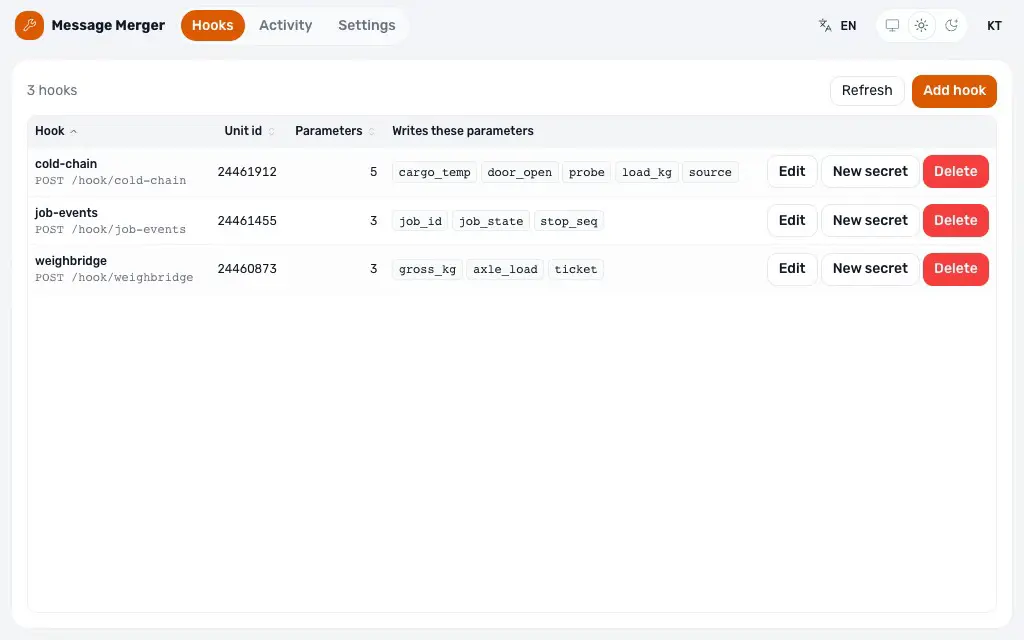
Each system posts to its own hook with its own field mapping, so adding a sender changes nothing for the ones already running.
A body of {"celsius": -18.4} arrives on the unit as the parameter the mapping names, beside everything the tracker sent.
A Wialon sensor bound to the parameter renders it in Wialon's own formatting — which is what a report prints and a notification tests.
Nothing about the unit's device changes. The imported messages sit alongside the tracker's own, on the same unit.
One import at a time across the account, a buffer per unit, and a dead letter for anything Wialon refuses, with the reason it gave.
Of the two ways into Wialon, the real-time one requires the unit's device type to be Wialon IPS. The HTTP import accepts any unit, so that is the path this takes.
This one is not self-serve yet. We stand the endpoint up against your account, configure the first sender with you, and hand over the admin app that shows what is configured and what the queue is doing.
Because IPS only accepts messages for a unit whose device type is Wialon IPS. A unit that already has a real tracker is not that, and changing its device type would cost the tracker. The HTTP import path accepts any unit, so that is the one used.
No. It lands as a message of its own at its own timestamp, beside the tracker's. A sensor bound to the parameter reads messages that carry that parameter and no position, which is worth knowing when a report expects coordinates on every row.
It can carry its own timestamp, but not a future one: Wialon silently rewrites anything ahead of the clock to the time it arrived, so nothing can be post-dated into the account.
Seconds, not milliseconds. The webhook is acknowledged immediately, the import is batched behind it, and acceptance by Wialon is not the same as the message being visible — which is why the admin app shows the queue rather than claiming success.
For this one job, yes: it puts the extra data on the unit without a second platform in the path. Where a customer already runs flespi, or needs real-time streaming rather than batches, flespi remains the better answer — and we build on it too.
Preview. The chain has run end to end on a live account: a webhook became a message, and a Wialon sensor bound to its parameter read it back as -18.40 °C in Wialon's own formatting. We are taking early users one at a time rather than listing it as finished.
A Wialon unit takes one tracker. Message Merger writes probe, weighbridge or ERP readings into that same unit as parameters sensors and reports can read.
Read moreRun Flespi and Wialon together without double truth: source-of-truth boundaries, normalized event contracts, replay-safe downstream analytics.
Read moreA modern Python client for the Wialon Remote API: login, search, live events with avl_evts — plus which libraries are alive and which died in 2013.
Read more“Our client needed a data pipeline. It came back working, plus a few Wialon fixes we had not asked for. That client trusts us more now.”
 Faiz K. Customer Manager · Trakpro Limited


